TRANSFORMING THE CLASSROOM WITH ARTIFICIAL INTELLIGENCE: OPPORTUNITIES, CHALLENGES AND FUTURE DIRECTIONS FOR CLASSROOM INSTRUCTION IN THE DIGITAL-AGE
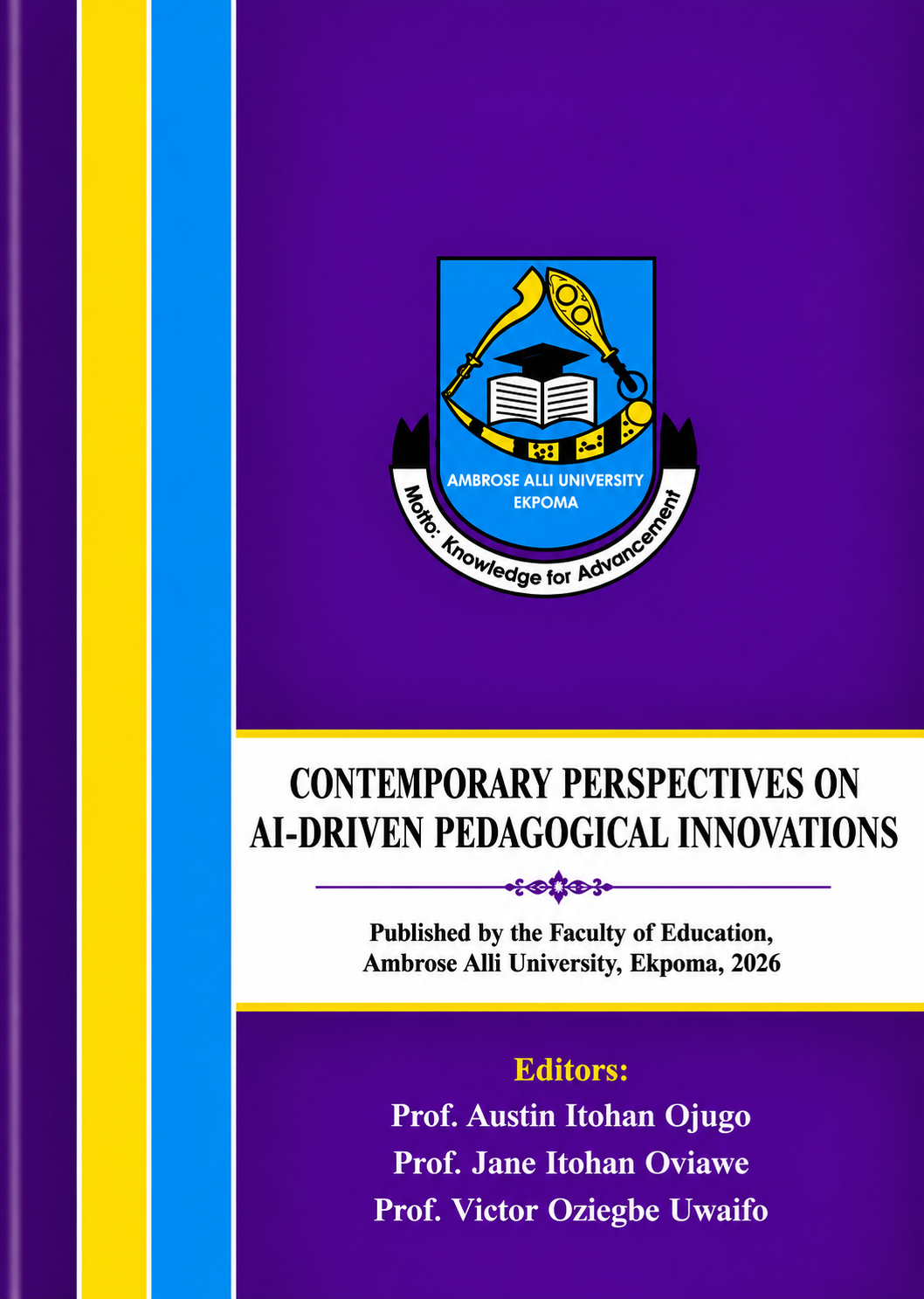
The Second lead paper presented at the 9th International Conference of the Faculty of Education, Ambrose Alli University, Ekpoma, held 28th to 30th July. 2026 at the International Conference Centre
Keywords:
Artificial Intelligence, AI in Education, Classroom Instruction, AI-Driven Pedagogy, Digital Education, Personalised Learning, Teacher Support, Nigerian Education System, Educational Technology, Human-AI Collaboration.Abstract
Artificial Intelligence (AI) is increasingly transforming classroom instruction by enabling personalised learning, adaptive teaching, automated assessment, real-time feedback, and data-driven educational decision-making. This paper examines the opportunities, challenges, and future directions associated with the integration of AI into classroom instruction, with particular emphasis on the Nigerian education system. It discusses the evolution of AI in education, its applications in modern teaching and learning, the changing role of teachers, AI-driven pedagogy, and emerging digital learning environments. The paper further examines the current state of AI adoption across Nigeria, highlighting government initiatives and state-level efforts to promote digital learning and AI integration. Despite its considerable potential, the adoption of AI in Nigerian classrooms is constrained by inadequate technological infrastructure, poor internet connectivity, limited digital and AI literacy, high implementation costs, resistance to technological change, ethical and privacy concerns, unequal access to technology, unreliable AI-generated information, overdependence on AI, and inadequate institutional and policy frameworks. The paper argues that effective AI integration requires a balanced human-AI approach, comprehensive teacher training, curriculum alignment, investment in digital infrastructure, ethical guidelines, data protection, AI literacy, and hybrid approaches that combine AI technologies with human supervision. It concludes that AI has significant potential to enhance the accessibility, flexibility, personalisation, and effectiveness of classroom instruction in Nigeria, provided that its adoption is guided by responsible governance, pedagogical objectives, equity, and human oversight.
References
### References
Agbarakwe, H. A., & Chibueze, O. O. (2024). Leveraging artificial intelligence for enhanced assessment and feedback mechanisms in Nigeria higher education system. *International Journal of Research and Innovation in Social Science*.
Ahmed, J., Soomro, A. K., & Naqvi, S. H. F. (2025). Barriers to AI adoption in education: Insights from teachers’ perspectives. *International Journal of Innovations in Science and Technology, 7*(1), 411–421.
Alashwal, M. (2024). Empowering education through AI: Potential benefits and future implications for instructional pedagogy. *PUPIL: International Journal of Teaching, Education and Learning*.
Anderson, T., & Dron, J. (2011). Three generations of distance education pedagogy. *International Review of Research in Open and Distributed Learning, 12*(3), 80–97. https://doi.org/10.19173/irrodl.v12i3.890
Audibert, R. B., Lemos, H., Avelar, P., Tavares, A. R., & Lamb, L. C. (2022). *On the evolution of artificial intelligence and machine learning*. arXiv.
Bhattacharya, N. (2025). School strategies, obstacles, and opportunities for incorporating generative AI into the classroom. *International Journal of Multidiscipline*.
Coursera Staff. (2025). *The history of AI: A timeline of artificial intelligence*. Coursera.
Eusebio, E. J. G., Baldera, P., Patiam, A. M., Villanueva, E. R., Gaa, N. A., Solis, A. M. F., Soriano, M. L. C., & Ribon, A. L. (2025). AI in the classroom: A systematic review of barriers to educator acceptance. *International Journal of Learning, Teaching and Educational Research, 24*(9), 126–147.
Federal Ministry of Education. (2019). *Implementation guidelines for the National Policy on Science and Technology Education*. Federal Ministry of Education.
Federal Ministry of Education. (2019). *National implementation guidelines for ICT in education*. Federal Ministry of Education.
Federal Ministry of Education. (2023). *National Digital Learning Policy* (Draft). Federal Ministry of Education.
Federal Ministry of Education (FME). (2026). *Nigerian Education Sector Renewal Initiative (NESRI): Technology & science education*. https://education.gov.ng
Federal Ministry of Education. (n.d.). *About eLearn*. Federal Ministry of Education.
Federal Ministry of Education. (n.d.). *eLearn: Your teaching resources in one place*. Federal Ministry of Education.
Federal Ministry of Education. (n.d.). *Technology and science education*. Federal Ministry of Education.
Garzón, J., Patiño, E., & Marulanda, C. (2025). Systematic review of artificial intelligence in education: Trends, benefits, and challenges. *Multimodal Technologies and Interaction, 9*(8), 84.
Graham, C. R. (2013). Emerging practice and research in blended learning. In M. G. Moore (Ed.), *Handbook of distance education* (3rd ed., pp. 333–350). Routledge.
Holmes, W., Bialik, M., & Fadel, C. (2019). *Artificial intelligence in education: Promises and implications for teaching and learning*. Center for Curriculum Redesign.
Karjian, R. (2024). *The history of artificial intelligence: Complete AI timeline*. TechTarget.
Kwashabawa, B. B., Kolapo, P. O., Onaolapo, S. A., & Adeniran, D. O. (2025). Artificial intelligence in Nigerian education: A necessity for school records management. *Sokoto Educational Review, 24*(2), 235–242.
Laurillard, D. (2012). *Teaching as a design science: Building pedagogical patterns for learning and technology*. Routledge.
Li, H., Xiao, R., Nieu, H., Tseng, Y.-J., & Liao, G. (2024). From unseen needs to classroom solutions: Exploring AI literacy challenges in K-12 education. arXiv.
Downloads
Published
Versions
- 2026-09-30 (3)
- 2026-09-30 (3)
Issue
Section
License
Copyright (c) 2026 STUDIES IN EDUCATION

This work is licensed under a Creative Commons Attribution-NonCommercial 4.0 International License.